Morée – early proto-Dada painting linked to Duchamp and the Arensberg circle”
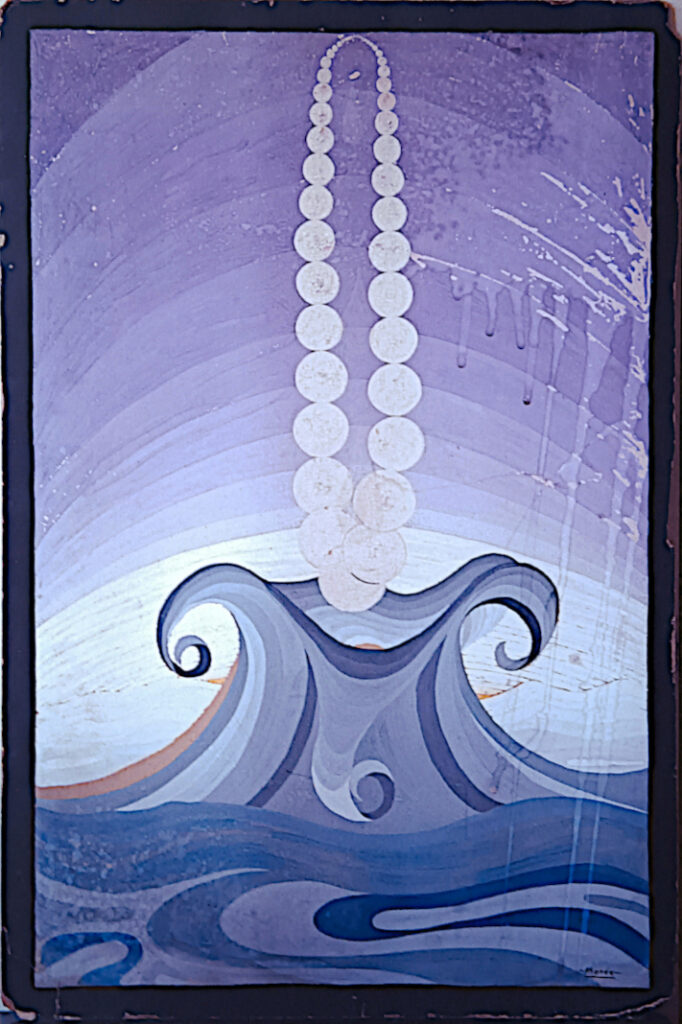
Morée (c. 1915–1916)
Morée is an undocumented early Dada-era painting, tentatively attributed to Marcel Duchamp and connected to the Arensberg circle. The work is structured around six coded gestures that anticipate and refract later developments in New York Dada.
- Author/Title Punning
Morée is a pseudonym that appears to pun on the name Erté, representing an early instance of intentional authorial ambiguity through naming.
- Subversion of Glamour
The pearls in Morée are not decorative but destabilized, stripped of elegance and suspended in corrosion. This gesture foreshadows Dada’s later subversion of bourgeois ornament, echoed in Da-Dandy (1919), Belle Haleine (1921), and at least one issue of 391.
- Drips as Sabotage
Morée appears to be the only known work employing a manually induced, subtractive drip process, using erasure rather than addition to disrupt surface meaning.
- Denial of Function
Morée is painted on a commercially produced mechanical art board intended for reproductive printing. By applying the corrosive stain, the artist renders the board unusable for its intended industrial function.
- Surface Disruption
A sharp implement is used to partially abrade the signature, physically removing part of the painted surface and enacting a literal erasure of authorship.
- Artistic Citation
The punctuated dots in the signature appear to reference Nude Descending a Staircase No. 2 and No. 3, both of which contain pearl-like forms. This also aligns with the shared photographic ground and black border visible in Nude No. 3 (1916).