Home
Guided Navigation
Everything you need to know in six pages.
Morée (1915–1916)
An Unseen Turning Point in the Origins of Dada
Morée is an undocumented painting from the New York circle surrounding Marcel Duchamp and the Arensbergs, created in 1915 or 1916 and unknown to scholarship until 2025.
Although small in scale, the work carries a conceptual charge disproportionate to its size: it is a private, coded intervention produced at the precise moment Duchamp was withdrawing from painting and reconfiguring the terms of authorship, surface, and symbolic meaning.
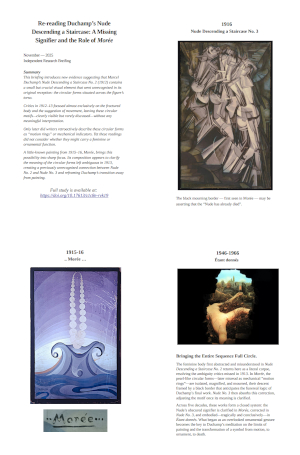
At first glance, the image presents a strand of pearls suspended against a dark, theatrical field. But what appears decorative collapses under scrutiny. The pearls are rendered in glossy relief; the background is casein, matte and eroded. Vertical drips cut violently through the image, suggesting not accident but sabotage. At the lower right, the signature is scraped back to a fragmentary pseudonym—“..Morée…”—its dots functioning like a conceptual hinge rather than a name.
Nothing in the painting behaves as it should.
Graphic Summary Quickiew
Why Morée Matters
The significance of Morée lies not in provenance (which is uncertain), but in the internal logic of the work itself and the way it aligns—precisely, repeatedly, and structurally—with Duchamp’s transformations of art between 1915 and 1917. The painting is self-documenting: its construction, surface disruptions, and coded gestures embed the conditions for its own interpretation.
Several elements position Morée at the threshold of New York Dada:
- Authorial refusal: The abraded signature predates the pseudonym “R. Mutt,” pushing the theme of withheld identity earlier than previously recorded.
- Surface disruption: Subtractive drips and the scraped signature operate as material violations of the surface, collapsing illusion and aligning the work with an emerging conceptual procedure rather than traditional painting.
- Drips as sabotage: The vertical “acidic” drips function deliberately, not decoratively, interrupting the image and cancelling
its stability. - Artistic citation: The black border and the treatment of the pearls resonate with contemporaneous developments in Duchamp’s Nude Descending a Staircase sequence and the emerging conceptual logic that culminates decades later in Étant donnés.
Taken together, these gestures are not accidental. They form a coordinated vocabulary—an encoded system of operations that reappears in key Dada works of the 1916–1917 period.
A Missing Link in Duchamp’s Conceptual Trajectory
The period in which Morée was created is the most understudied and least visually documented in Duchamp’s career: the Arensberg years, when he abandoned retinal painting, developed his pseudonymous strategies, and laid the groundwork for conceptual art. Morée sits squarely inside this gap.
The painting does not resemble any known work by Duchamp, Picabia, or Man Ray superficially—yet structurally, it aligns with all of them exactly where the record goes silent. The logic embedded in the work allows it to be read forward and backward: toward Fountain, Tu m’, and Étant donnés, and backward toward the misread pearls of Nude Descending a Staircase No. 2.
Its meaning is not supplied by context; the painting generates the context.
What This Site Offers
This website presents a rigorous, step-by-step examination of Morée:
- A formal analysis of the painting’s surface, materials, and structure
- The coded gestures embedded within the work
- The timeline that situates Morée inside the Arensberg years
- The relationship between Morée and the Nude sequence
- The conceptual bridge from this work to Duchamp’s later practice
- A comprehensive system showing how Morée was designed to reveal itself only in posterity
- Nothing here requires speculative provenance.
The argument is built from publicly verifiable evidence, internal consistency, and the painting’s own logic.
Why Now?
Morée remained hidden for nearly 110 years. Its resurfacing in 2024 reactivates a dormant structure inside Duchamp’s work—a structure that could not be recognized without the painting itself. This site does not propose an alternative history; it clarifies an existing one that lacked a missing component.
The implications are significant: Morée repositions the timeline of New York Dada, reframes Duchamp’s withdrawal from painting, and reveals a concealed conceptual architecture that extends from 1915 to the completion of Étant donnés in 1966.
This is where the story begins.